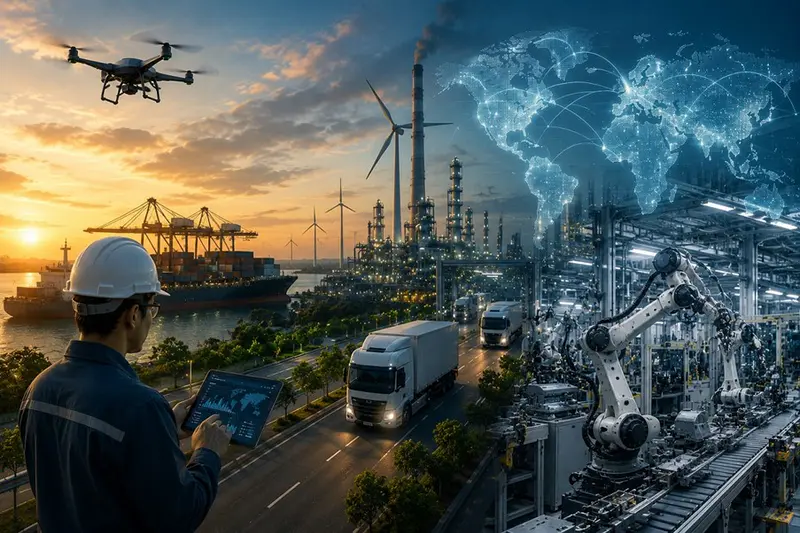
For years, conversations about technology focused heavily on consumer innovation.
Smartphones transformed communication. Streaming changed entertainment. Artificial intelligence reshaped digital platforms. Social media altered culture and commerce. The most visible technology companies became household names because their products influenced everyday life directly.
But beneath the surface of the global economy, another transformation has been unfolding far more quietly — one that may ultimately prove even more significant.
Industries traditionally viewed as slow-moving are undergoing profound technological reinvention.
Manufacturing, logistics, energy, agriculture, construction, transportation, and industrial infrastructure are all being reshaped by automation, predictive analytics, artificial intelligence, robotics, and connected systems. These changes rarely generate the same public excitement as consumer technology launches, yet they are quietly redefining how the modern economy functions at its core.
In many ways, the next major phase of global innovation may not happen primarily on smartphone screens or social platforms.
It may happen inside warehouses, supply chains, industrial networks, transportation systems, and operational infrastructure most consumers rarely think about at all.
This shift matters enormously because industries form the operational backbone of the global economy. They influence productivity, trade, employment, energy efficiency, inflation, supply chain resilience, and long-term economic growth.
And increasingly, these industries are entering a new era where technology is no longer simply improving operations — it is reshaping the definition of industrial competitiveness itself.
Historically, industrial sectors evolved gradually. Large infrastructure systems changed slowly because implementation costs were high, operational risk was significant, and technological transitions required enormous coordination. Innovation often focused on incremental efficiency improvements rather than rapid reinvention.
That model is changing.
Artificial intelligence now predicts equipment failures before they occur. Robotics increasingly automate repetitive manufacturing tasks. Smart sensors monitor industrial performance continuously. Logistics systems optimize delivery routes in real time. Cloud infrastructure allows industrial operations to analyze enormous volumes of operational data instantly.
What once required reactive management increasingly becomes predictive.
This transition is quietly transforming how industries operate globally.
According to McKinsey research, advanced automation, AI-driven analytics, and industrial digitization could generate trillions of dollars in economic value over the coming decade as companies modernize operational systems worldwide.
https://www.mckinsey.com/capabilities/operations/our-insights
The scale of this transformation is difficult to overstate.
For decades, many industrial sectors prioritized efficiency primarily through labor optimization and physical infrastructure expansion. Today, competitiveness increasingly depends on intelligence — the ability to interpret data, anticipate disruption, optimize systems dynamically, and adapt rapidly to changing conditions.
This represents a meaningful philosophical shift.
Industries are no longer competing solely through production capacity. Increasingly, they compete through operational responsiveness and technological adaptability.
One reason this transition matters so much is because recent global disruptions exposed vulnerabilities many businesses previously underestimated.
Supply chain interruptions, geopolitical instability, labor shortages, climate-related events, and inflationary pressures revealed how interconnected and fragile industrial systems had become. Companies that once prioritized maximum efficiency suddenly recognized the importance of resilience, visibility, and operational flexibility.
As a result, industries globally accelerated investment into:
- predictive systems
- automation
- supply chain intelligence
- digital infrastructure
- industrial AI
- operational analytics
This acceleration is changing not only how industries operate, but also how businesses think about risk itself.
Historically, industrial resilience often depended heavily on scale. Larger infrastructure, greater inventory capacity, and broader operational reach created competitive advantages.
Now resilience increasingly depends on visibility.
Companies want real-time insight into operations, logistics, supplier networks, and infrastructure systems. Data itself is becoming a strategic industrial asset.
This explains why industrial technology is now expanding far beyond traditional manufacturing environments.
Agriculture increasingly relies on predictive analytics and precision monitoring systems. Energy companies deploy AI-driven infrastructure management tools. Logistics firms optimize distribution through automation and real-time analytics. Construction firms integrate digital modeling and connected equipment systems into large-scale projects.
Industries historically perceived as traditional are becoming increasingly intelligent.
Interestingly, much of this transformation remains relatively invisible to ordinary consumers.
People may notice faster deliveries or fewer supply shortages, but they rarely see the technological infrastructure quietly coordinating these outcomes behind the scenes.
Yet this operational layer may become one of the most economically important areas of innovation over the next decade.
According to Deloitte’s manufacturing and industrial outlook research, industrial organizations increasingly prioritize digital transformation, automation, and connected operational ecosystems to improve resilience and long-term competitiveness.
https://www2.deloitte.com/global/en/pages/manufacturing/articles/manufacturing-industry-outlook.html
This shift also reflects changing expectations surrounding efficiency itself.
For years, efficiency often meant maximizing output while minimizing cost. While those goals remain central, industries now increasingly recognize that long-term sustainability requires more than operational speed alone.
Flexibility is becoming valuable. Predictability is becoming valuable. Adaptability is becoming valuable.
The industries most likely to lead the future may not simply be those producing the most at the lowest cost.
They may increasingly be the organizations capable of adapting fastest to uncertainty without sacrificing operational stability.
This distinction matters enormously because uncertainty itself has become more persistent within the global economy.
Climate risks continue influencing infrastructure planning. Geopolitical tensions reshape trade patterns. Cybersecurity threats target critical systems. Labor markets evolve under automation pressure. Energy transitions require large-scale industrial adaptation.
In this environment, industries increasingly require systems capable not only of efficiency, but also resilience.
Artificial intelligence is playing a particularly important role in this transition.
AI systems now support:
- predictive maintenance
- inventory optimization
- quality control
- supply chain forecasting
- energy management
- industrial cybersecurity
- logistics coordination
Operationally, the benefits are substantial. Downtime can be reduced significantly. Energy usage becomes more efficient. Predictive systems improve maintenance scheduling. Resource allocation becomes more dynamic.
But AI also introduces new strategic questions.
How dependent should industries become on automated systems?
How should businesses balance efficiency with human oversight?
What happens when interconnected systems fail unexpectedly?
How can companies maintain operational trust in increasingly algorithmic environments?
As industries become more technologically sophisticated, transparency and system reliability become increasingly important.
This creates an interesting paradox for industrial innovation.
The more advanced industrial systems become technically, the more valuable human judgment and operational trust become alongside them.
According to PwC’s industrial manufacturing analysis, AI and digital infrastructure are expected to transform operational decision-making significantly, while also increasing the importance of governance, resilience, and workforce adaptation.
https://www.pwc.com/gx/en/industries/industrial-manufacturing.html
This transition is also reshaping workforce expectations.
Historically, industrial work was often associated primarily with physical labor and repetitive processes. Today, industrial environments increasingly require digital literacy, analytical thinking, and technological adaptability.
Workers now interact with:
- connected systems
- AI-supported workflows
- predictive platforms
- robotics integration
- data-driven operational tools
As a result, industrial transformation increasingly depends not only on technology itself, but also on workforce evolution.
This may become one of the defining economic challenges of the next decade.
Industries globally must modernize infrastructure while simultaneously helping workforces adapt to rapidly changing operational environments.
Importantly, this does not necessarily mean human labor becomes less valuable.
In many cases, the opposite may be true.
As automation handles repetitive tasks, human roles increasingly shift toward:
- problem-solving
- oversight
- strategic decision-making
- systems management
- operational judgment
This reflects a broader trend visible across many sectors of the economy.
Technology often changes the nature of work more than it eliminates work entirely.
Another interesting aspect of this industrial transformation is how quietly it is happening.
Consumer technology tends to dominate public attention because it feels immediate and visible. Industrial innovation operates differently. It unfolds inside factories, infrastructure systems, warehouses, ports, energy networks, and supply chains largely outside everyday visibility.
Yet these systems shape the modern economy profoundly.
They influence inflation, product availability, energy reliability, global trade efficiency, and national economic competitiveness. In many ways, industrial technology forms the hidden operating system beneath modern life itself.
That hidden importance may become increasingly visible in the years ahead.
The future global economy will likely depend heavily on whether industries can modernize successfully while maintaining resilience during periods of uncertainty.
The countries and companies adapting most effectively may strengthen long-term economic advantages significantly.
The future of industry will unquestionably remain technological. Artificial intelligence, robotics, predictive analytics, cloud infrastructure, digital twins, and connected operational ecosystems will continue reshaping industrial sectors rapidly over the next decade.
But another quieter transformation may occur alongside technological advancement.
The industries most likely to succeed may not simply be those adopting the most advanced technologies first.
They may be the organizations integrating innovation in ways that create stability, resilience, and long-term operational confidence.
That distinction matters enormously.
Technology improves efficiency. But resilience sustains economies.
In many ways, the industrial world is rediscovering something it temporarily overlooked during years dominated by speed and optimization.
Operational strength is not only about moving faster.
It is also about remaining adaptable when the world becomes less predictable.
And over the next decade, that realization may quietly redefine how industries compete, how economies grow, and how technological leadership itself is ultimately measured.